
Drone Battery
Ultra-High Energy Density Packs: Push the Limits of Long-Range Flight
To answer the burning question—what’s the furthest distance a drone can fly?—you have to look beyond the airframe and into the chemistry of your power source. While standard consumer rigs struggle to hit 30 minutes, our high-performance drone battery selection is engineered for pilots who need to push past the 10km mark and into the realm of long-range endurance. Whether you are chasing 100km milestones with fixed-wing hybrids or looking for punchy LiPos for freestyle, we provide the hardware that prevents ‘DOA support’ nightmares.
Technical Specifications & Chemistry Comparison
Battery Type
Energy Density
Discharge Rate (C)
Best For
Lithium Polymer (LiPo)
Medium
75C – 150C
FPV Racing & Freestyle
Lithium-Ion (Li-ion)
High
10C – 35C
Long Range & Endurance
Solid State (Emerging)
Very High
Low/Medium
Commercial Surveying
Engineering Analysis: Solving the ’12V Problem’ and Voltage Sag
In my 10+ years of FPV engineering, I’ve seen countless pilots lose expensive rigs because they didn’t understand discharge curves. A common issue reported in the community is the ’12V Battery Problem,’ where internal resistance spikes cause the drone to drop out of the sky despite showing remaining capacity. To avoid this, we recommend landing when your battery hits 3.5V per cell. If you notice your 4th LED blinking 2 times on repeat, that’s often a signal of cell imbalance or a ‘ghosted’ BMS.
For those flying ‘nice’ batteries, don’t be afraid to push them, but always ensure they are secured with reinforced Battery Straps to prevent ejection during high-G maneuvers. When you’re back at the bench, utilizing high-precision Balance Chargers is non-negotiable for maintaining cell health and preventing the dreaded ‘middle battery won’t charge’ syndrome. Always store your high-capacity packs in Fireproof Bags to mitigate risks from crash-damaged cells or bent corners.
Frequently Asked Questions
What kind of battery is used in drones?
Most modern drones use Lithium Polymer (LiPo) or Lithium-Ion (Li-ion) batteries. LiPo batteries are the industry standard for high-discharge applications like FPV because they are light and can deliver massive bursts of power. Li-ion batteries offer higher energy density, making them the choice for long-endurance flights where weight-to-capacity ratios are critical.
Can a drone fly 100 km?
Yes, but typically only specialized fixed-wing commercial or military drones with hybrid propulsion systems can achieve distances over 100 km (60 miles). Consumer multi-rotors are usually limited to a 5-10 km range due to battery capacity and signal penetration constraints.
How long will a drone battery last?
A standard consumer drone battery lasts between 20-40 minutes. Entry-level models usually hover around 20 minutes, while premium platforms like the DJI Mavic series or Autel EVO can reach up to 45 minutes under ideal conditions. Custom-built long-range FPV drones using Li-ion packs can also push into the 30-50 minute window.
Can a drone fly for 24 hours?
Standard untethered drones cannot fly for 24 hours. However, ‘Tethered Drones’ connected to a ground-based power station can stay airborne indefinitely, with some systems recently tested for non-stop 24-hour flights in challenging conditions for surveillance and emergency relay purposes.
Which is better, a Li-ion or LiPo battery?
It depends on your flight style. Li-ion is better for slow, steady flights where you need maximum time in the air (high energy density). LiPo is better for racing, freestyle, or heavy-lift drones that require high discharge rates to perform aggressive maneuvers without massive voltage sag.
Top products in Drone Battery
- Nova H4S-125 Smart Flight Battery - $109.00
- Drone Batteries & Charger
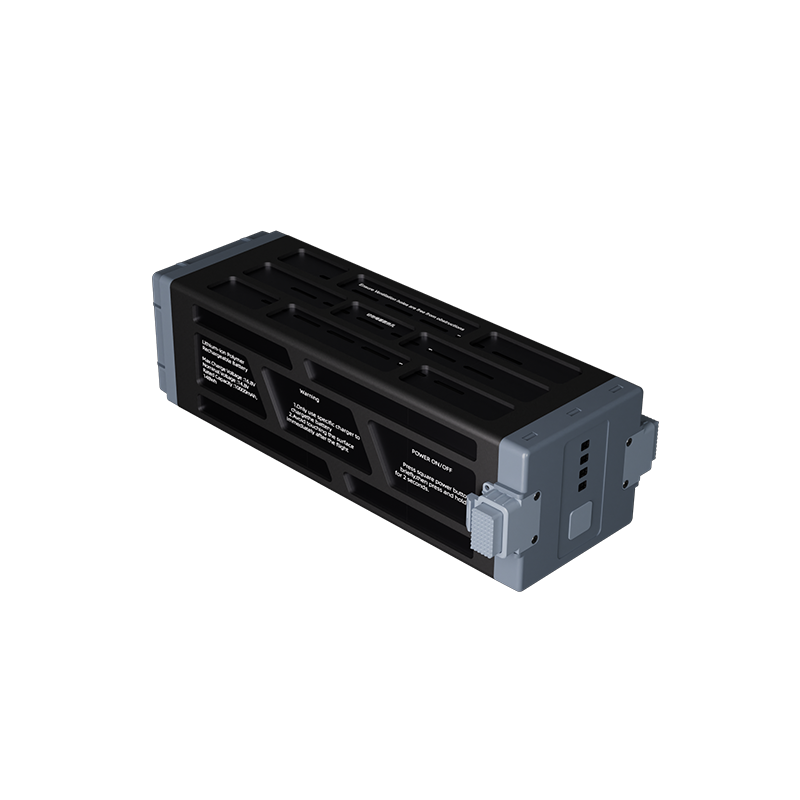
Nova H4S-125 Smart Flight Battery
$109.00Nova H4S-125 Smart Flight Battery — professional UAV component from 100drone. Former DJI R&D team. Compatible with DJI drones. Email [email protected] for pricing.
How to choose Drone LiPo Battery
| 3S 11.1V | Standard for 5-inch FPV builds |
|---|---|
| 4S 14.8V | Mid-size builds and heavier 5-inch frames |
| 6S 22.2V | High-performance 5-inch and most 7-inch long-range builds |
| High C-rating | For aggressive throttle punches and heavy payloads |
Compatibility checklist before you buy
- Cell count: The battery cell count must match the motor KV and the ESC voltage rating, and the connector must physically fit
- C-rating: A higher C-rating allows a bigger burst current, but the pack must still be able to deliver it - a cheap pack rated high may sag under load
- Capacity: Capacity trades against weight; more mAh means more flight time but a heavier build
- Connector: XT60, XT30 and EC5 are not interchangeable without an adapter
What pilots and builders report in the field
phantompilots.comPilot forum thread on replacement battery availability for a specific airframe, a recurring pain point when a platform is discontinued and original packs become scarce.
www.dronetrest.comCommunity build guide using a 3S 11.1V 6000mAh 50C pack with XT60, XT90 and EC5 connectors listed alongside the rest of the parts.
Frequently asked questions
What C-rating do I need for a drone battery?
The C-rating tells you the maximum continuous discharge current as a multiple of the capacity. A 2200mAh 60C pack can theoretically deliver around 132A. More is not always better - the pack still has to supply that current without excessive voltage sag, and oversized packs add weight. Match the rating to how aggressively you punch the throttle.
How do I store LiPo batteries safely between flights?
Store them at around 3.8V per cell with the leads removed or the main connector unplugged, in a fire-resistant bag away from heat and direct sun. Do not leave a pack fully charged or fully empty for long periods. Community practice is to check the voltage of a stored pack every few weeks.
What connector do I need for my drone battery?
The common ones are XT60 for 4S-6S, XT30 for 3S-4S and XT90 for 6S and above, with EC5 used on some heavy-lift platforms. The connector has to match the ESC lead and the battery lead - the physical shape differs and polarity arrangements are not always the same. An adapter works but adds weight and a possible failure point.
Ultra-High Energy Density Packs: Push the Limits of Long-Range Flight
To answer the burning question—what’s the furthest distance a drone can fly?—you have to look beyond the airframe and into the chemistry of your power source. While standard consumer rigs struggle to hit 30 minutes, our high-performance drone battery selection is engineered for pilots who need to push past the 10km mark and into the realm of long-range endurance. Whether you are chasing 100km milestones with fixed-wing hybrids or looking for punchy LiPos for freestyle, we provide the hardware that prevents ‘DOA support’ nightmares.
Technical Specifications & Chemistry Comparison
Battery Type
Energy Density
Discharge Rate (C)
Best For
Lithium Polymer (LiPo)
Medium
75C – 150C
FPV Racing & Freestyle
Lithium-Ion (Li-ion)
High
10C – 35C
Long Range & Endurance
Solid State (Emerging)
Very High
Low/Medium
Commercial Surveying
Engineering Analysis: Solving the ’12V Problem’ and Voltage Sag
In my 10+ years of FPV engineering, I’ve seen countless pilots lose expensive rigs because they didn’t understand discharge curves. A common issue reported in the community is the ’12V Battery Problem,’ where internal resistance spikes cause the drone to drop out of the sky despite showing remaining capacity. To avoid this, we recommend landing when your battery hits 3.5V per cell. If you notice your 4th LED blinking 2 times on repeat, that’s often a signal of cell imbalance or a ‘ghosted’ BMS.
For those flying ‘nice’ batteries, don’t be afraid to push them, but always ensure they are secured with reinforced Battery Straps to prevent ejection during high-G maneuvers. When you’re back at the bench, utilizing high-precision Balance Chargers is non-negotiable for maintaining cell health and preventing the dreaded ‘middle battery won’t charge’ syndrome. Always store your high-capacity packs in Fireproof Bags to mitigate risks from crash-damaged cells or bent corners.
Frequently Asked Questions
What kind of battery is used in drones?
Most modern drones use Lithium Polymer (LiPo) or Lithium-Ion (Li-ion) batteries. LiPo batteries are the industry standard for high-discharge applications like FPV because they are light and can deliver massive bursts of power. Li-ion batteries offer higher energy density, making them the choice for long-endurance flights where weight-to-capacity ratios are critical.
Can a drone fly 100 km?
Yes, but typically only specialized fixed-wing commercial or military drones with hybrid propulsion systems can achieve distances over 100 km (60 miles). Consumer multi-rotors are usually limited to a 5-10 km range due to battery capacity and signal penetration constraints.
How long will a drone battery last?
A standard consumer drone battery lasts between 20-40 minutes. Entry-level models usually hover around 20 minutes, while premium platforms like the DJI Mavic series or Autel EVO can reach up to 45 minutes under ideal conditions. Custom-built long-range FPV drones using Li-ion packs can also push into the 30-50 minute window.
Can a drone fly for 24 hours?
Standard untethered drones cannot fly for 24 hours. However, ‘Tethered Drones’ connected to a ground-based power station can stay airborne indefinitely, with some systems recently tested for non-stop 24-hour flights in challenging conditions for surveillance and emergency relay purposes.
Which is better, a Li-ion or LiPo battery?
It depends on your flight style. Li-ion is better for slow, steady flights where you need maximum time in the air (high energy density). LiPo is better for racing, freestyle, or heavy-lift drones that require high discharge rates to perform aggressive maneuvers without massive voltage sag.